How Long Does It Take to Learn Spanish
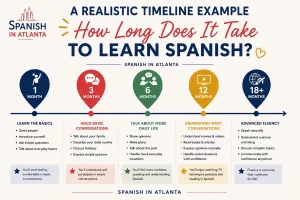
How Long Does It Take to Learn Spanish?
If you’re thinking about learning Spanish, chances are you’ve asked yourself one very important question:
“How long does it take to learn Spanish?”
The honest answer is…
It depends.
I know that’s probably not the answer you were hoping for, but don’t worry—I won’t leave you hanging with vague advice.
After teaching Spanish for over 33 years and helping thousands of adult students from all over the United States, I’ve learned something surprising:
Most people dramatically overestimate how difficult Spanish is while simultaneously underestimating what they can accomplish with the right learning system.
The truth is that Spanish is actually considered one of the easiest foreign languages for native English speakers to learn. The U.S. Foreign Service Institute (FSI), which trains American diplomats, classifies Spanish as a Category I language—the easiest group for English speakers—and estimates approximately 600–750 hours of guided learning to reach professional working proficiency.
But here’s the good news…
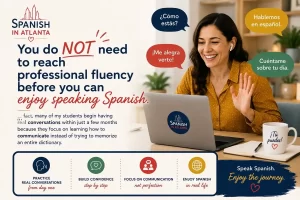
You do NOT need to reach professional fluency before you can enjoy speaking Spanish.
In fact, many of my students begin having real conversations within just a few months because they focus on learning how to communicate instead of trying to memorize an entire dictionary.
Throughout this guide, I’ll explain exactly:
- How long it takes to learn Spanish
- What affects your learning speed
- How long it takes to become conversational
- Whether adults can still become fluent
- The biggest mistakes that slow learners down
- The fastest way to learn Spanish
- And how you can dramatically shorten your learning timeline.
Let’s begin.
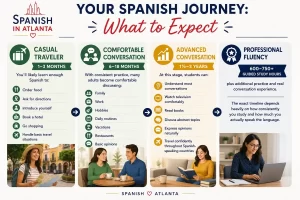
The Short Answer
If you’re looking for the quickest answer possible…
Here it is.
Casual Traveler
1–3 months
You’ll likely learn enough Spanish to:
- Order food
- Ask for directions
- Introduce yourself
- Book a hotel
- Go shopping
- Handle basic travel situations
- Basic everyday small talk
Comfortable Conversation
6–18 months
With consistent practice, many adults become comfortable discussing:
- Family
- Work
- Hobbies
- Daily routines
- Vacations
- Restaurants
- Basic opinions
Advanced Conversation
1½–3 years
At this stage, students can:
- Understand most conversations
- Watch television comfortably
- Read books
- Discuss abstract topics
- Express opinions naturally
- Travel confidently throughout Spanish-speaking countries
Professional Fluency
Typically requires:
600–750+ guided study hours plus additional practice and real conversation experience. The exact timeline depends heavily on how consistently you study and how much you actually speak the language.
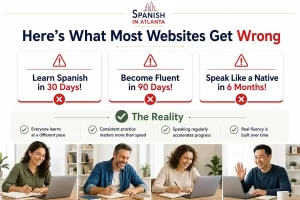
Here’s What Most Websites Get Wrong
Many websites promise things like:
- Learn Spanish in 30 Days!
- Become Fluent in 90 Days!
- Speak Like a Native in 6 Months!
Those headlines generate clicks.
Unfortunately…
They aren’t realistic for most students.
Can someone make incredible progress in three months?
Absolutely.
Can the average adult with a full-time job become completely fluent in ninety days?
Probably not.
Learning Spanish isn’t about finding some magical shortcut.
It’s about consistently doing the right things.
The encouraging news is that you don’t need to be perfect to start enjoying the language.
Most people don’t need perfect grammar.
They simply want to:
- Communicate with family.
- Travel with confidence.
- Speak to coworkers.
- Help Spanish-speaking customers.
- Feel comfortable on vacation.
- Understand conversations.
Those goals happen much sooner than complete fluency.
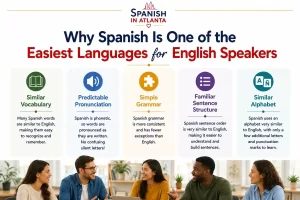
Why Spanish Is One of the Easiest Languages for English Speakers
One reason Spanish is so popular is because it’s remarkably logical compared to many other languages.
Here are just a few reasons why adults often progress quickly:
Pronunciation Is Consistent
Unlike English, Spanish words are usually pronounced exactly as they are written.
Once you learn the sounds of each letter, you can pronounce thousands of new words correctly.
Thousands of Words Are Similar
English and Spanish share thousands of related words.
Examples include:
- Important → Importante
- Hospital → Hospital
- Animal → Animal
- Restaurant → Restaurante
- Doctor → Doctor
- Perfect → Perfecto
- Family → Familia
These are called cognates, and they give English speakers a significant head start.
Grammar Is Predictable
Although Spanish verb conjugations initially seem intimidating, they actually follow consistent patterns.
Once students understand those patterns, learning becomes much easier.
That’s one reason I emphasize understanding instead of memorization in my classes.
Spanish Is Spoken Almost Everywhere
Spanish is one of the most widely spoken languages in the world, with hundreds of millions of native speakers across numerous countries.
That means you’ll have endless opportunities to practice through travel, friendships, movies, podcasts, books, music, and everyday interactions.
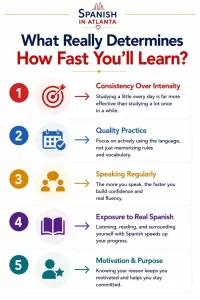
What Really Determines How Fast You’ll Learn?
After teaching adults for more than three decades, I’ve noticed that success has surprisingly little to do with intelligence.
Instead, these five factors make the biggest difference.
1. Consistency
Learning 20–30 minutes every day is usually much more effective than studying four hours every Saturday.
Your brain remembers information better when it’s exposed to it frequently.
Consistency almost always beats intensity.
2. Speaking From Day One
This is probably the biggest mistake I see.
Many students spend months:
- Reading
- Watching videos
- Using apps
- Memorizing vocabulary
But they rarely speak.
Speaking is a skill.
You improve speaking by…
Speaking.
From the very beginning.
3. Getting Feedback
Practicing mistakes over and over simply reinforces bad habits.
That’s why professional feedback can dramatically accelerate progress.
Even small pronunciation corrections can save months of frustration later.
4. Following a Structured Learning Plan
Random YouTube videos.
Random vocabulary lists.
Random apps.
Random grammar lessons.
This approach usually creates lots of knowledge…
But very little confidence.
Students progress much faster when every lesson builds upon the previous one.
5. Motivation
Adults who have a clear reason for learning Spanish almost always learn faster.
Examples include:
- Better career opportunities
- Traveling through Latin America or Spain
- Speaking with family members
- Communicating with customers
- Preparing for retirement abroad
- Personal growth
Having a meaningful reason makes it much easier to stay committed when motivation naturally rises and falls.
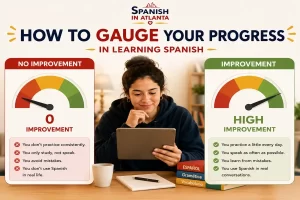
The Biggest Myth About Learning Spanish
Here’s something I tell my students all the time:
Don’t measure your progress by the calendar. Measure it by what you can do.
Instead of asking:
“Have I been studying for six months?”
Ask yourself:
- Can I introduce myself?
- Can I order at a restaurant?
- Can I describe my family?
- Can I ask questions?
- Can I understand a simple conversation?
- Can I tell someone about my weekend?
Those milestones matter far more than simply counting months.
Can You Learn Spanish in 3 Months?
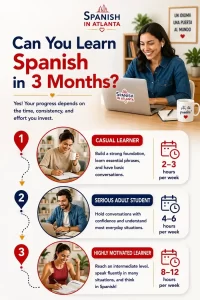
One of the most common questions I hear is:
“Can I learn Spanish in three months?”
The honest answer is:
Yes… but it depends on what you mean by “learn.”
If your goal is to become completely fluent, hold deep conversations about politics, watch every Netflix series without subtitles, and write essays…
No.
That’s simply not realistic for most adults.
However…
If your goal is to:
- Introduce yourself
- Order food confidently
- Travel comfortably
- Understand basic conversations
- Ask and answer questions
- Talk about your family
- Describe your job
- Handle common daily situations
Then absolutely!
I’ve had many adult students make incredible progress within just three months because they focused on learning the right material instead of trying to learn everything.
One of the biggest secrets to learning Spanish faster is understanding that not all Spanish material is equally important.
__________________________________________________________________________________________
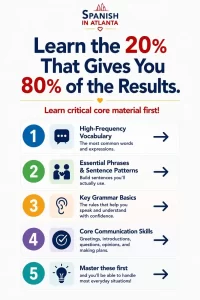
Learn the 20% That Gives You 80% of the Results
Have you ever heard of the 80/20 Rule (Pareto Principle)?
It applies beautifully to language learning.
A relatively small amount of vocabulary and grammar appears over and over again in everyday conversations.
Instead of memorizing thousands of random words, successful students focus on learning:
- The most common verbs
- The 2 most important sentence structures
- Critical vocabulary
- Everyday expressions
- Real conversations
For example, verbs like:
- Ser
- Estar
- Tener
- Ir
- Hacer
- Poder
- Querer
- Venir
appear constantly.
Mastering these common verbs will have a much bigger impact than memorizing dozens of rare vocabulary words you’ll almost never use.
How Many Hours Should You Study Each Week?
Another question I hear all the time is:
“How many hours should I study Spanish?”
There isn’t one perfect answer.
Instead, let’s look at realistic expectations.
Casual Learner
2–3 hours per week
Great for:
- vacations
- hobbies
- casual interest
Progress will be steady but slower.
Serious Adult Student
4–6 hours per week
This is where I see tremendous progress.
Students usually develop conversational confidence much faster because they’re consistently practicing.
Highly Motivated Learner
8–12+ hours per week
These students often improve surprisingly quickly.
They’re usually preparing for:
- relocation
- work
- family
- travel
- business opportunities
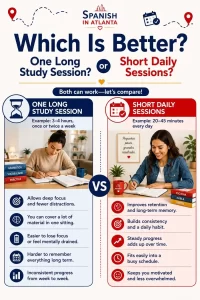
One Long Study Session?
or
Short Daily Sessions?
Without question…
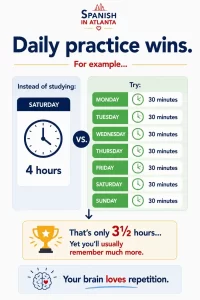
Daily practice wins.
For example…
Instead of studying:
Saturday
4 hours
Try:
Monday
30 minutes
Tuesday
30 minutes
Wednesday
30 minutes
Thursday
30 minutes
Friday
30 minutes
Saturday
30 minutes
Sunday
30 minutes
That’s only 3½ hours…
Yet you’ll usually remember much more.
Your brain loves repetition.
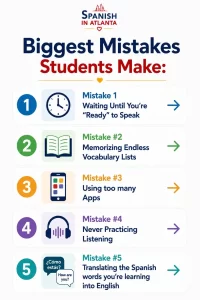
Over the years, I’ve noticed that struggling students usually make the same mistakes.
Let’s save you months—or even years—of frustration.
Mistake #1
Waiting Until You’re “Ready” to Speak
This is probably the biggest mistake adults make.
Many students tell me:
“I want to learn more grammar first.”
or
“I don’t know enough vocabulary yet.”
Here’s the truth:
You never feel completely ready.
Speaking is a skill.
The only way to improve speaking…
is by speaking.
Even if you make mistakes.
Especially if you make mistakes.
Mistake #2
Memorizing Endless Vocabulary Lists
Vocabulary is important.
But random vocabulary isn’t.
Would you rather know:
- helicopter
- volcano
- octopus
- microscope
or know the vocabulary words that help you have basic conversations & ask basic questions:
- I need help.
- Where is the bathroom?
- I don’t understand.
- How much does it cost?
- I’d like a coffee.
- Can you repeat that?
Real communication always wins.
Mistake #3
Using Too Many Apps
This surprises people.
Apps are wonderful tools.
But they’re only one piece of learning.
Some students use:
Duolingo
Babbel
Memrise
Quizlet
YouTube
TikTok
Five grammar books
Three podcasts
…all at the same time.
The result?
Information overload.
Instead of mastering one system…
they constantly jump between twenty different systems.
Mistake #4
Never Practicing Listening
Reading Spanish and understanding spoken Spanish are two different skills.
Native speakers don’t pause between every word.
They speak naturally.
Listening practice should become part of your routine from the very beginning. That is why we have created Spanish audio files in our Spanish learning program so students can
listen to them on their phone often!
Mistake #5
Trying to Be Perfect
Perfection slows learning.
Communication accelerates learning.
Many adults worry about:
“What if I make mistakes?” OR “What if I sound dumb?”
The answer is simple.
You will make mistakes and most people feel flattered that you are learning their language;
a language you don’t have to learn but chose to learn! People respect this effort!
Even advanced speakers continue making occasional mistakes.
Progress—not perfection—should always be your goal. Remember communication & genuine connection are
the goal nothing else!
What’s the Fastest Way to Learn Spanish?
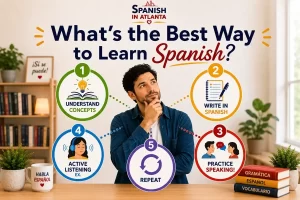
If someone asked me today…
“Delilah, what’s the fastest way to learn Spanish?”
I’d answer with 3 words.
Consistency. Structured program & Routine practice!
Here’s the system I recommend.
Step 1
Learn the material.
Understand it.
Don’t simply memorize it.
Step 2
Practice writing.
Writing forces your brain to organize information correctly.
Step 3
Speak.
Every lesson should include speaking.
Not eventually.
Immediately.
Step 4
Listen.
Your ears need training just as much as your mouth.
Step 5
Get Feedback & Repeat
This is one of the biggest advantages of learning with a professional instructor.
If you’re making the same pronunciation mistake twenty times…
you probably won’t notice it yourself.
An experienced instructor can often correct that habit in just a few minutes.
That saves enormous amounts of time later. Professional instruction also provides
the structure you need to focus on what matters and avoid learning dead ends!
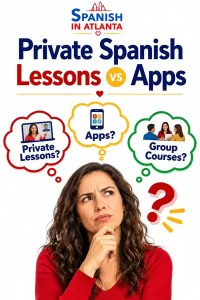
Language Apps
Pros
✔ Convenient
✔ Affordable
✔ Great for vocabulary review
✔ Fun
Cons
✘ Limited conversation
✘ Little personalized feedback
✘ Easy to lose motivation
Apps are excellent supplements. They are the side dish to your mental meal only!
They’re rarely complete learning systems.
Self-Study
Pros
Flexible
Low cost
Learn at your own pace
Cons
No accountability
No speaking practice
No personalized corrections
Easy to develop bad habits
No experience in learning a language!
Private Spanish Lessons
Pros
Personalized instruction
Immediate feedback
Conversation practice
Custom learning plan
Faster progress
Cons
Higher investment
Requires scheduling
For adults with specific goals, private lessons often provide the fastest path because every lesson is tailored to the student’s needs.
Small Group Spanish Classes

Small groups combine many of the advantages of private instruction while giving students the opportunity to practice with others.
Students benefit from:
- real conversations
- accountability
- instructor guidance
- structured lessons
- interaction with classmates
Many adults enjoy this balance because it’s motivating, interactive, and often more affordable than one-on-one instruction.
There isn’t one universal answer.
The best method depends on:
- your schedule
- your personality
- your goals
- your budget
- how quickly you want to improve
Some learners thrive with independent study.
Others make much faster progress with live instruction and regular conversation practice.
The important thing is choosing a method you can consistently stick with.
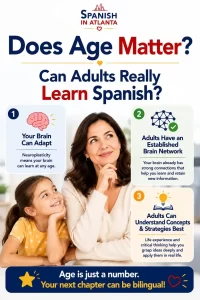
Does Age Matter? Can Adults Really Learn Spanish?
One of the biggest myths about learning Spanish is that adults simply can’t learn languages as well as children.
Fortunately…
That isn’t true.
Children and adults learn differently.
Children often have the advantage of time and constant exposure.
Adults have advantages that children don’t.
Adults:
- recognize patterns faster
- understand grammar explanations
- have stronger problem-solving skills
- know how they personally learn best
- are usually more disciplined
In fact, many of my fastest students have been adults in their 40s, 50s, 60s and even 70s.
Age is rarely the obstacle.
Consistency and the right program are the way adults thrive!
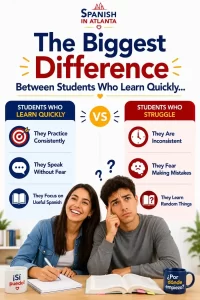
The Biggest Difference Between Students Who Learn Quickly…
…and those who struggle.
After teaching Spanish for over three decades…
I’ve noticed something fascinating.
The fastest learners are almost never the most talented.
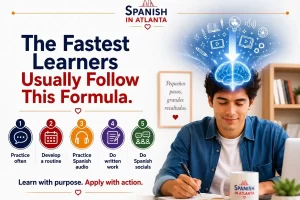
They’re simply the most consistent & follow a structured routine!
The students who improve the fastest usually do these things.
They Practice Speaking Every Week
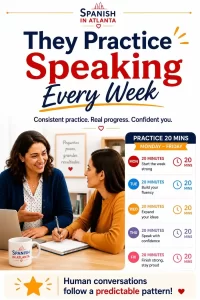
Not once a month.
Every week.
Even ten minutes of conversation makes a huge difference.
Speaking builds confidence.
Confidence builds motivation.
Motivation builds consistency.
Consistency builds fluency.
They Don’t Obsess Over Grammar
This surprises people.
Grammar is important.
Very important.
But communication comes first.
Many students wait until they “know enough.”
The problem?
That day never comes.
The students who improve fastest accept that they’ll make mistakes…
…and speak anyway. You learn to color with the crayons you’ve been given vs
waiting until you have all the colors in your collection.

They Review Old Material
Learning isn’t only about adding new information.
It’s about strengthening old information.
Think about going to the gym.
You don’t lift one weight one time…
…and expect lifelong muscles.
Language learning works exactly the same way.
Review creates long-term memory.
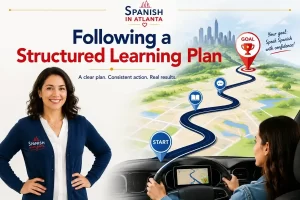
They Build Daily Habits
One lesson.
One podcast.
One conversation.
One worksheet.
One short reading.
Tiny actions.
Repeated consistently.
Over months…
those tiny actions become remarkable progress.
The brain learns to connect and merge what you’ve learned with
the new material you are learning to create a network!
A Realistic Timeline
Let’s imagine two students.
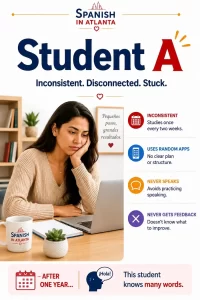
Studies once every two weeks.
Uses random apps.
Never speaks.
Never gets feedback.
After one year…
This student knows many words.
But still lacks confidence.
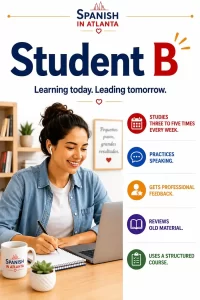
Studies three to five times every week.
Practices speaking.
Gets professional feedback.
Reviews old material.
Uses a structured course.
After one year…
This student is often having conversations…
traveling confidently…
and enjoying Spanish.
Notice something?
Neither student is more intelligent.
They simply followed different systems and organized themselves!
What If You Want to Learn Spanish FAST?
Then your focus shouldn’t be:
“How can I study more?”
Instead ask…
“How can I study BETTER?”
Huge difference.
20%
Learning new material.
80%
Practicing.
Unfortunately…
Many students reverse that.
They spend:
80%
Learning
20%
Practicing
That’s why progress feels slow.
Here’s My Favorite Analogy
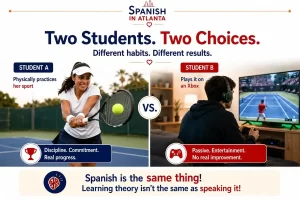
Imagine someone reading books about tennis.
They read…
“The Perfect Forehand.”
“The Science of Tennis.”
“The Complete Tennis Encyclopedia.”
“The Psychology of Champions.”
Do they become a great tennis player?
Of course not.
Eventually…
They have to pick up the racket.
Spanish works exactly the same way.
You cannot become conversational by reading about conversations.
You become conversational…
by having conversations.

This depends on your personality.
Some people thrive independently.
Others need accountability.
Ask yourself.
Do you normally finish online courses?
Do you consistently stick with goals?
Can you motivate yourself after a long workday?
If the answer is yes…
Self-study may work well.
If the answer is no…
Working with an instructor or small group often makes learning much easier.
What Makes Someone Fluent?

This question surprises many students.
Fluency doesn’t mean…
Knowing every word.
Perfect grammar.
Never making mistakes.
Native pronunciation.
Instead…
Fluency means…
You can communicate comfortably.
You understand most everyday conversations.
You can express your ideas naturally. You can think less…
and speak more. That’s fluency.
The Best Learning Strategy I Have Ever Seen
After teaching thousands of adults…
Here’s the system I recommend.
Step 1
Understand the material.
Don’t memorize blindly.
Understand critical formulas & core concepts only!
Step 2
Write.
Writing strengthens memory. The brain is forced to
slow down as you write and this helps retention greatly!
Step 3
Speak.
Immediately.
Not six months later. Simple sentences
everyday situation. Use and reuse the vocabulary
you have already learned in conversation.
Step 4
Listen.
Train your ears. Listen to audio files. Spanish mini stories
Start with beginner Spanish stories first and then use more
advanced listening options like a Spanish podcast!
Step 5
Repeat.
Every week.
Not every month.
Let’s be honest.
Every learner eventually hits a plateau.
That’s normal.
Here’s what I tell my students.
Don’t compare yourself…
to someone who’s studied for ten years.
Compare yourself…
to who you were last month.
Can you now…
Introduce yourself?
Order food?
Describe your family?
Talk about work?
Understand a simple podcast?
Those are victories.
Celebrate them.

Maybe you want to…
Travel confidently.
Speak with family.
Get promoted.
Help customers.
Enjoy retirement overseas.
Meet new people.
Whatever your reason…
Keep it in front of you.
Purpose creates persistence.
Persistence creates results.
Frequently Asked Questions About Learning Spanish
Over the past 33 years, I’ve been asked thousands of questions by adult Spanish learners. Here are the answers to some of the most common ones.

Can I Learn Spanish at 40, 50 or 60?
Absolutely.
Some of my most successful students started learning Spanish later in life.
In fact, mature students often have several advantages over younger learners:
- Better discipline
- More patience
- Clearer goals
- Better study habits
- More life experience
Learning a language is not about age.
It’s about consistency.
If you practice regularly and use effective learning strategies, you can absolutely become conversational regardless of your age.
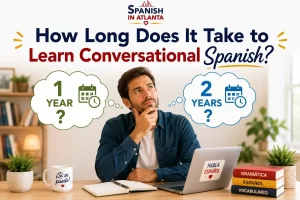
How Long Does It Take to Learn Conversational Spanish?
This depends on several factors:
- How often you study
- Whether you practice speaking
- The quality of instruction
- Your motivation
- Your learning method
For many adults studying consistently, conversational ability often develops within several months. Becoming comfortable in a wide variety of conversations generally takes longer and varies from person to person.
Remember…
Conversation isn’t about speaking perfectly.
It’s about communicating confidently.
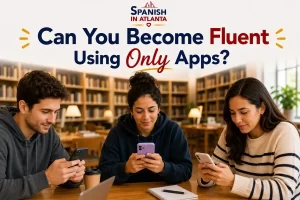
Apps are wonderful tools.
I recommend them frequently.
However…
Apps alone usually aren’t enough.
Why?
Because language is communication.
Communication requires interaction.
Apps are excellent for:
✅ Vocabulary
✅ Review
✅ Daily practice
But eventually you’ll need:
- Conversation
- Listening
- Personalized corrections
- Feedback
- Real interaction
Is Spanish Difficult?
Compared to many other foreign languages…
No.
Spanish is considered one of the most accessible languages for native English speakers because of its pronunciation system, grammar patterns and shared vocabulary.
That doesn’t mean it’s effortless.
It simply means your progress can be surprisingly fast when you follow a structured learning plan.
What’s the Best Way to Learn Spanish?
After teaching adults for more than three decades…
Here’s what consistently works.
Learn
↓
Practice
↓
Speak
↓
Listen
↓
Repeat
Week after week.
Month after month.
That’s how confidence develops.
Should I Take Private Lessons or Group Classes?

The answer depends on your goals.
Private lessons are excellent if you want:
- personalized instruction
- maximum flexibility
- accelerated progress
- customized lessons
Small group classes are excellent if you enjoy:
- practicing with classmates
- interactive activities
- accountability
- a structured curriculum
- learning in a supportive environment
Both approaches can be extremely effective.
The important thing is choosing the one that matches your learning style.
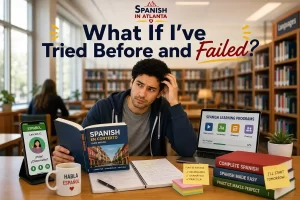
This may be the most important section in this article.
Many adults tell me:
“I’ve tried learning Spanish before.”
“My high school Spanish disappeared.”
“I’ve forgotten everything.”
“I guess I’m just not good at languages.”
I don’t believe that.
Most people didn’t fail because they lacked ability.
They failed because they lacked the right system.
Maybe they:
- memorized instead of communicating
- never practiced speaking
- studied inconsistently
- lost motivation
- didn’t receive professional feedback
Those are learning problems.
Not intelligence problems.
I’ve seen countless adults regain confidence once they began learning in a structured, supportive environment.
How to Stay Motivated During Your Spanish Journey
Learning a language is similar to improving your fitness.
Some days you’ll feel unstoppable.
Other days…
Not so much.
That’s perfectly normal.
Here are a few ways to stay motivated:
Celebrate Small Wins
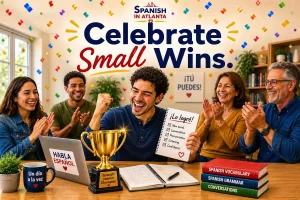
Don’t wait until you’re fluent.
Celebrate when you:
- order food in Spanish
- understand a conversation
- finish a chapter
- complete a worksheet
- hold your first five-minute conversation
Small victories eventually become huge achievements.
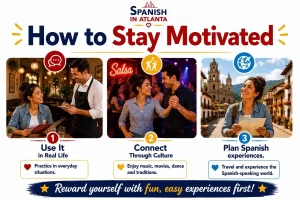
Practice Things You Enjoy
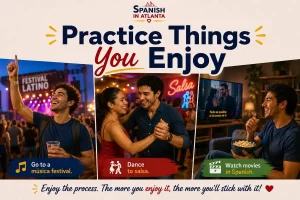
Watch movies.
Listen to music.
Travel.
Read interesting articles.
Cook Spanish recipes.
Play language games.
Learning should be enjoyable.
Compare yourself to the person you were last month.
That’s the only comparison that truly matters.
One of the greatest joys of my career has been watching adults discover that they are capable of much more than they believed.
I’ve seen students who began with:
“I’ll never learn Spanish.”
Months later…
They’re confidently introducing themselves.
Traveling.
Making friends.
Helping customers.
Speaking with family.
Those moments remind me why I continue teaching after more than three decades.
There is something incredibly rewarding about watching someone gain confidence in a new language.
Ready to Learn Spanish?
If you’ve read this far…
Congratulations.
You’re already taking the first step toward learning one of the most useful languages in the world.
Whether your goal is to:
- travel
- communicate with family
- advance your career
- prepare for retirement
- help customers
- or simply challenge yourself
Learning Spanish is an investment that can enrich your life for years to come.
The key isn’t finding the perfect shortcut.
The key is finding the right learning system and staying consistent.
Learn Spanish with Spanish in Atlanta
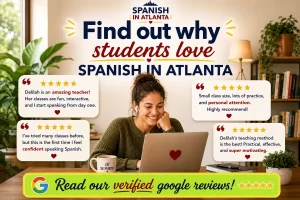
If you’re looking for professional Spanish instruction designed specifically for adults, we’d love to help.
At Spanish in Atlanta, we specialize in helping busy adults build real conversational confidence through live online instruction.
Our programs include:
✅ Live Zoom classes
✅ Small groups (maximum of four students)
✅ Private Spanish lessons
✅ Professional instructor with over 33 years of teaching experience
✅ Interactive lessons
✅ Custom-designed learning materials
✅ Practice worksheets
✅ Audio resources
✅ Video lessons
✅ Personalized feedback
Whether you’re a complete beginner or looking to improve your current skills, we’ll help you build confidence one conversation at a time.

One of the biggest mistakes people make is enrolling in the wrong level.
Starting too high creates frustration.
Starting too low creates boredom.
That’s why we offer a FREE Spanish Assessment and Placement Test.
We’ll evaluate your current level, answer your questions, and recommend the learning path that best fits your goals.
Whether you’re interested in private lessons or one of our highly interactive small-group classes, we’ll help you make an informed decision.
👉 Schedule your FREE Spanish Assessment today and take the first step toward speaking Spanish with confidence.
Final Thoughts
So…
How long does it take to learn Spanish?
The answer isn’t measured only in months or years.
It’s measured by your consistency, your practice habits, and your willingness to keep showing up.
Every conversation.
Every lesson.
Every worksheet.
Every small victory.
Those moments gradually build the confidence you’ve been looking for.
Remember…
You don’t have to become fluent overnight.
You simply have to become a little better than yesterday.
One day you’ll look back and realize that the language that once seemed impossible has become part of your everyday life.
¡Buena suerte y mucho éxito en tu aprendizaje del español!

You may also like